




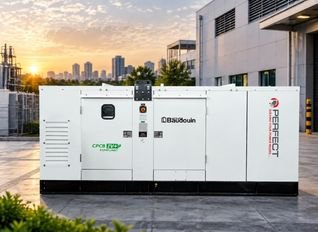
How to Calculate the Right Generator Capacity for Your Power Requirements
Selecting the correct generator capacity is one of the most important steps when planning a backup or prime power system.
A generator that is too small may struggle to support the connected equipment, while selecting a much larger generator than necessary can increase the initial investment and may result in inefficient operation.
The right approach is to calculate the actual electrical load, consider equipment starting requirements, understand the relationship between kW and kVA, and then select a generator appropriate for the application’s operating conditions.
This guide explains how to approach generator capacity calculation step by step.
What Does Generator Capacity Mean?
Generator capacity refers to the amount of electrical power a generator is designed to supply under its specified operating conditions.
Generator sets are commonly rated in kVA (kilovolt-amperes), while electrical equipment is often specified in kW (kilowatts).
When selecting a generator, you need to understand both ratings because the electrical loads connected to the generator may have different power factors.
Generator capacity is therefore not determined simply by adding the wattage of every appliance or machine.
You also need to consider:
- Running load
- Starting load
- Power factor
- Load diversity
- Generator operating mode
- Future load requirements
- Site conditions
Step 1: List All Equipment That the Generator Will Power
Start by creating a complete list of the equipment that may operate from the generator.
For example, a commercial facility might have:
| Equipment | Rated Load |
|---|---|
| Lighting | 5 kW |
| Air conditioning | 15 kW |
| Water pumps | 8 kW |
| Computers and office equipment | 4 kW |
| Refrigeration | 8 kW |
| Other loads | 5 kW |
| Total | 45 kW |
This is an illustrative example, not a recommendation for an actual installation.
For a real generator-sizing exercise, use the equipment manufacturer’s rated electrical data wherever possible.
Step 2: Calculate the Running Load
The running load is the electrical power consumed while equipment is operating normally.
If all the listed loads in the example above operate simultaneously:
5 + 15 + 8 + 4 + 8 + 5 = 45 kW
Therefore:
Total running load = 45 kW
However, this doesn’t automatically mean that a 45 kW generator is the correct choice.
Why?
Because we still need to consider power factor, starting loads and operating requirements.
Step 3: Understand kW and kVA
This is one of the most important concepts in generator sizing.
kW
Kilowatt (kW) represents real or active electrical power.
It is the portion of electrical power that performs useful work.
kVA
Kilovolt-ampere (kVA) represents apparent power.
Generator alternators are commonly rated in kVA because the electrical system is affected by both real power and reactive power.
The commonly used relationship is:
kW = kVA × Power Factor
Therefore:
kVA = kW ÷ Power Factor
Step 4: Convert kW to kVA
Let’s continue with the example.
Suppose the calculated running load is:
45 kW
And assume a power factor of:
0.8
Then:
kVA = 45 ÷ 0.8
kVA = 56.25 kVA
So the calculated apparent-power requirement is approximately:
56.25 kVA
But again, this does not automatically mean that a 56.25 kVA generator should be purchased.
Starting loads and other operating requirements still need to be evaluated.
Step 5: Consider Starting Loads
This is where generator sizing becomes more important.
Some electrical equipment can draw substantially more current when starting than when running normally.
This can occur with equipment such as:
- Electric motors
- Pumps
- Compressors
- Fans
- Air-conditioning equipment
- Certain industrial machinery
For example, a pump might have a relatively moderate running load but create a significantly higher electrical demand during startup.
If the generator is selected only according to the steady-state running load, it may experience:
- Voltage dips
- Frequency fluctuations
- Difficulty starting motors
- Overload conditions
- Unstable operation
Therefore, starting requirements need to be considered when selecting generator capacity.
Step 6: Identify the Largest Starting Load
If your application contains motors or other equipment with significant starting requirements, identify:
- The normal running load
- The starting current or starting kVA
- Which equipment starts first
- Whether multiple loads start simultaneously
- Whether loads can be started sequentially
Sequential starting can sometimes reduce the instantaneous demand placed on the generator.
However, the appropriate approach depends on the electrical system and equipment.
For an industrial installation with multiple motors, pumps or compressors, a detailed load assessment is particularly important.
Step 7: Consider the Generator’s Operating Mode
The required generator capacity can also depend on how the generator will be used.
Standby Generator
A standby generator is generally used as a backup source when the normal utility supply fails.
Examples include:
- Offices
- Commercial buildings
- Homes
- Healthcare facilities
- Industrial facilities requiring backup power
The generator may operate for relatively limited periods depending on the application.
Prime Power Generator
A prime power generator can be used as a primary source of electrical power under defined operating conditions.
Applications can include:
- Remote locations
- Construction projects
- Temporary power
- Industrial operations
- Sites with limited or unavailable grid supply
If the generator is intended for prime power, the expected operating profile and load should be evaluated carefully.
Step 8: Consider Load Diversity
Not every electrical load necessarily operates at its rated capacity at the same time.
For example:
- Multiple air-conditioning systems may cycle.
- Pumps may operate intermittently.
- Some production equipment may run only during certain processes.
- Office equipment may have different operating patterns.
Understanding the actual operating profile can provide a more realistic picture of the required generator capacity.
However, critical loads and possible simultaneous operation should not be ignored simply to reduce the generator size.
The calculation should reflect the realistic worst-case operating condition appropriate for the application.
Step 9: Consider Future Load Growth
Generator sizing should not only consider today’s requirements if significant expansion is already planned.
A facility may later add:
- Additional machinery
- HVAC equipment
- Pumps
- Production lines
- Servers
- Lighting
- Charging systems
If future expansion is known, it should be considered during the initial power-system design.
At the same time, the generator should not be unnecessarily oversized based on hypothetical loads that may never be added.
The goal is to make a reasonable assessment of current requirements and realistic planned growth.
Step 10: Consider Site Conditions
Generator output and system design can also be influenced by the installation environment.
Consider:
Ambient Temperature
High temperatures can affect engine and cooling-system performance.
Altitude
Higher elevations can affect engine performance because of changes in air density.
Dust
Construction, mining and industrial environments can expose equipment to dust and other contaminants.
Ventilation
Adequate airflow is important for engine cooling and combustion.
Installation Location
Indoor and outdoor installations can have different ventilation, exhaust, acoustic and enclosure requirements.
These factors should be evaluated when finalizing generator capacity and configuration.
Worked Generator Sizing Example
Let’s consider a simplified commercial application.
Loads
| Load | Running Power |
|---|---|
| Lighting | 5 kW |
| HVAC | 15 kW |
| Pump | 8 kW |
| Office equipment | 4 kW |
| Refrigeration | 8 kW |
| Other equipment | 5 kW |
| Total | 45 kW |
Step 1 — Running Load
Total = 45 kW
Step 2 — Assume Power Factor
For illustration:
Power factor = 0.8
Step 3 — Convert to kVA
45 ÷ 0.8 = 56.25 kVA
So the calculated apparent-power requirement is approximately:
56.25 kVA
Step 4 — Evaluate Starting Loads
Now determine whether the pump, HVAC system or other motor-driven equipment creates a significant starting requirement.
If it does, the generator may need additional capacity or an appropriate starting strategy.
Step 5 — Evaluate Operating Conditions
Finally, consider:
- Standby or prime operation
- Ambient conditions
- Future load growth
- Required control system
- Installation requirements
Only after these factors are evaluated should the appropriate generator model and rating be finalized.
This example demonstrates the calculation method only; it should not be used as a final equipment-selection recommendation.
Generator Capacity for Different Applications
The required capacity can vary significantly depending on the application.
Home
Residential generator requirements may include:
- Lighting
- Refrigerators
- Fans
- Air conditioning
- Water pumps
- Security systems
- Selected appliances
The most important step is deciding which loads actually need backup power.
Commercial Buildings
Commercial facilities may have:
- HVAC systems
- Lighting
- Pumps
- Lifts
- IT systems
- Security systems
- Refrigeration
The load profile should be evaluated rather than estimating generator size from building area alone.
Construction Sites
Construction sites can have changing electrical loads.
Equipment may include:
- Power tools
- Pumps
- Compressors
- Lighting
- Site offices
- Temporary facilities
Starting loads and mobility requirements can be particularly important.
Industrial Facilities
Industrial applications may involve:
- Large motors
- Pumps
- Compressors
- Production equipment
- Process machinery
- Automation systems
These applications often require more detailed engineering analysis because starting loads, synchronization, load sharing and operating conditions can significantly affect generator selection.
Do You Need a 100 kVA Generator for a 100 kW Load?
Not necessarily.
This is a common misunderstanding.
If an application requires 100 kW at a power factor of 0.8, the apparent power requirement would be:
100 ÷ 0.8 = 125 kVA
So a 100 kVA generator would not simply be equivalent to a 100 kW load at a 0.8 power factor.
However, actual generator selection also depends on the generator’s rated performance, load characteristics and operating conditions.
Should You Choose a Generator Larger Than Your Calculated Load?
Some capacity margin may be appropriate depending on the application, but simply choosing a substantially larger generator is not always the best approach.
An oversized generator can mean:
- Higher purchase cost
- Potentially less efficient operation at low loads
- Larger physical footprint
- Higher installation requirements
An undersized generator can lead to:
- Overloading
- Voltage instability
- Frequency problems
- Difficulty handling starting loads
- Reduced reliability
The objective is to select a generator that is appropriately matched to the actual application.
Generator Capacity and Control Systems
Generator sizing should also be considered alongside the required control system.
For example, a larger or more complex installation may require:
- AMF
- ATS
- Generator monitoring
- Synchronization
- Load sharing
- PLC automation
Perfect House’s control-panel range includes DG Manual/AMF/ATS panels, synchronizing panels and PLC-based automation panels for different power-system requirements.
Therefore, generator capacity and control requirements should ideally be considered together during system planning.
Common Generator Sizing Mistakes
1. Adding Appliance Wattages Without Considering Starting Loads
Running load alone may not represent the generator’s actual peak requirement.
2. Confusing kW and kVA
These are related but different electrical ratings.
3. Selecting the Generator Based Only on Building Size
Two buildings of similar size can have very different electrical loads.
4. Ignoring Power Factor
Power factor affects the relationship between kW and kVA.
5. Ignoring Future Requirements
Planned expansion can change the appropriate generator capacity.
6. Automatically Choosing the Biggest Generator
More capacity is not automatically better.
7. Ignoring Site Conditions
Temperature, altitude, ventilation and environmental conditions can affect the generator installation and performance.
Generator Sizing Checklist
Before selecting a generator, determine:
Electrical Load
- Total connected load
- Normal running load
- Maximum expected load
- Power factor
- kW requirement
- kVA requirement
Starting Requirements
- Motor loads
- Starting current
- Starting kVA
- Largest motor
- Simultaneous starting requirements
Operating Profile
- Standby or prime
- Expected operating hours
- Typical load
- Maximum load
- Future expansion
Site Conditions
- Ambient temperature
- Altitude
- Dust and environmental conditions
- Ventilation
- Indoor or outdoor installation
System Requirements
- AMF
- ATS
- Synchronization
- Load sharing
- Automation
- Monitoring
Once these factors are known, you have a much stronger basis for selecting the appropriate generator capacity.
Final Thoughts
Calculating generator capacity is more than adding up the wattage of the equipment you want to operate.
A reliable calculation should consider running load, starting load, kW, kVA, power factor, operating mode, load profile, future requirements and site conditions.
For a simple installation, the calculation may be relatively straightforward. Commercial and industrial applications can require a more detailed assessment, particularly when motors, compressors, pumps or multiple generators are involved.
The best generator is not necessarily the largest one. It is the generator that is appropriately matched to the application’s electrical and operating requirements.
If you’re planning a generator installation and need help evaluating your power requirement, start by documenting your connected loads, operating profile and starting requirements before selecting the generator capacity.
Explore the generator range or generator control panels for the next stage of your power-system planning.