




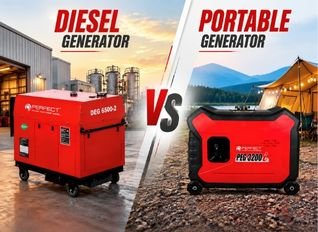
Diesel Generator vs Portable Generator: How to Choose the Right Power Solution
Choosing between a diesel generator and a portable generator depends on how and where you need power. A small portable generator may be suitable when mobility, compact size and temporary power are the main priorities. A larger diesel generator can be more appropriate when an application requires higher capacity, longer operating periods, structured installation or dependable power for commercial and industrial loads.
The right choice therefore isn’t simply about which type of generator is more powerful. It is about matching the generator to the load, application, operating duration, mobility requirements and site conditions.
In this guide, we’ll compare the two options and explain what to consider before selecting a generator.
What Is a Diesel Generator?
A diesel generator is a generating set that uses a diesel engine to drive an alternator and produce electrical power.
Diesel generator sets are available across a wide range of capacities and can be used for applications ranging from smaller commercial requirements to large industrial power systems.
Depending on the configuration, a diesel generator may be used for:
- Standby power
- Prime power
- Commercial facilities
- Construction projects
- Industrial applications
- Mining operations
- Oil and gas applications
- Rental power
- Remote power requirements
The generator range on the website includes models from smaller capacities such as 30 kVA through much larger generator sets, including Baudouin models listed up to 2500 kVA and beyond in the current catalogue.
What Is a Portable Generator?
A portable generator is designed with mobility and relatively simple deployment in mind.
Portable generators can be moved between locations depending on the application and are useful when electrical power is required temporarily or at different locations.
The current Perfect Global Generators portable range includes:
- Petrol-engine portable generators
- Diesel-engine portable generators
- Diesel welders
The listed portable products include models such as PEG 1200i, PEG 3200i, PEG 7000i, DEG 6500-2 and DEG 7000i. Portable generators can therefore serve a different purpose from larger fixed or permanently installed generator systems.
Diesel Generator vs Portable Generator: Key Differences
The most useful way to compare the two is to look at the requirements of the application.
| Factor | Diesel Generator | Portable Generator |
|---|---|---|
| Typical use | Commercial, industrial, standby and prime power | Temporary and mobile power |
| Capacity | Available across a broad/high-capacity range | Generally suited to smaller loads |
| Mobility | Often installed at a designated location | Designed for easier movement |
| Operating duration | Suitable for extended operation depending on model and duty | Better suited to portable/temporary applications |
| Installation | May require dedicated installation | Generally simpler deployment |
| Applications | Industrial, commercial, construction, mining, oil & gas | Small sites, temporary work, events and mobile applications |
| Control options | Can support advanced control and automation configurations | Depends on model and application |
| Power system integration | Suitable for larger electrical systems | Generally used as an independent power source |
These are general distinctions. The exact capabilities depend on the generator model and configuration.
1. Consider the Required Power Capacity
Power requirement should be the first consideration. If you need to operate a small number of basic electrical loads, a portable generator may provide sufficient capacity.
For larger requirements involving multiple machines, HVAC systems, pumps, motors or industrial equipment, a higher-capacity diesel generator may be more appropriate.
Before selecting either option, identify:
- Total connected load
- Normal running load
- Starting loads
- Motor loads
- Required kVA
- Required kW
- Power factor
- Expected future load
Don’t select a generator simply because its rated capacity appears close to your current load. The generator needs to be suitable for the actual electrical characteristics of the equipment being powered.
2. Think About Portability
Portability is one of the clearest differences between the two options. If you need to move the generator between different locations, a portable generator can provide an important practical advantage.
For example, portable power may be useful for:
- Temporary work locations
- Small construction activities
- Maintenance work
- Outdoor activities
- Mobile operations
- Temporary equipment
On the other hand, if the generator will remain at a fixed commercial or industrial facility, portability may be less important than capacity, control, installation and long-term operating requirements.
3. Consider How Long the Generator Will Operate
The expected operating duration should also influence your decision. Ask:
Will the generator operate occasionally, or will it provide power for extended periods?
A generator used occasionally as backup has a different operating profile from a generator supplying power to a remote project every day.
For longer-duration applications, evaluate:
- Fuel capacity
- Fuel consumption
- Engine specifications
- Cooling system
- Maintenance intervals
- Load profile
- Service requirements
The appropriate generator should be selected based on the manufacturer’s specified operating conditions.
4. Compare the Applications
Different applications create different generator requirements.
Home and Small Backup Applications
A portable generator may be appropriate when only selected essential loads need temporary power.
Examples can include:
- Lighting
- Small appliances
- Refrigeration
- Small pumps
- Basic electrical equipment
However, the actual load should always be calculated before selecting the generator.
Commercial Applications
Commercial facilities can have more complex requirements.
Loads may include:
- Lighting
- HVAC
- Pumps
- Security systems
- IT equipment
- Refrigeration
- Building services
Depending on the required capacity and backup arrangement, a commercial facility may need a larger diesel generator rather than a portable unit.
Construction Applications
Construction sites can benefit from portable power when equipment needs to be powered at different locations.
However, larger construction projects may require higher-capacity diesel generator systems when supplying:
- Multiple machines
- Pumps
- Site offices
- Lighting systems
- Cranes or other equipment
- Temporary distribution systems
The choice should therefore be based on the site’s actual load and how the power system will be deployed.
Industrial Applications
Industrial applications generally require more detailed power assessment.
Equipment can include:
- Motors
- Pumps
- Compressors
- Production machinery
- Process equipment
- Automation systems
- Material-handling equipment
Where the required load is substantial or the generator needs to operate as part of a larger power system, a higher-capacity diesel generator may be more suitable.
5. Don’t Ignore Starting Loads
One of the most common generator-selection mistakes is looking only at the running load. Motors and other inductive equipment can require additional current when starting.
For example, a pump may have a relatively predictable running load but require a higher electrical input during startup.
If the generator cannot accommodate the starting requirement, you may experience:
- Voltage dips
- Frequency instability
- Equipment starting problems
- Generator overload
- Unreliable operation
This is particularly important for commercial, construction and industrial applications. A proper generator assessment should therefore consider both running and starting loads.
6. Consider Fuel and Operating Requirements
Fuel type is another consideration.
The current portable-generator category includes both petrol-engine and diesel-engine products. The choice between petrol and diesel depends on the specific generator, application and expected operating conditions.
For a generator that operates frequently, consider:
- Fuel availability
- Fuel consumption
- Operating hours
- Maintenance requirements
- Storage requirements
- Total operating cost
For a portable generator, ease of deployment may be more important than maximizing long-term fuel efficiency.
For a larger diesel generator, fuel consumption and operating efficiency can become significant considerations because the generator may operate for extended periods or under substantial loads.
7. Consider Installation Requirements
A portable generator is generally intended for relatively straightforward deployment according to the manufacturer’s installation and safety requirements.
A larger diesel generator can involve considerably more planning.
Depending on the application, installation may require consideration of:
- Foundation
- Ventilation
- Exhaust
- Fuel system
- Cable routing
- Electrical distribution
- Earthing
- Acoustic treatment
- Weather protection
- Access for maintenance
For larger commercial and industrial installations, these requirements should be considered before purchasing the generator.
8. Think About Generator Controls
Control requirements can also influence the choice.
A larger generator installation may require features such as:
- Automatic mains failure
- Automatic transfer
- Generator monitoring
- Engine protection
- Voltage monitoring
- Frequency monitoring
- Synchronization
- Load sharing
- Remote monitoring
For example, Perfect House’s control-panel range includes DG Manual/AMF/ATS panels, synchronizing panels and PLC-based automation panels.
If the generator is going to be integrated into a larger electrical system, the control architecture should be considered along with the generator itself.
9. Consider Maintenance
Every generator requires appropriate maintenance, regardless of whether it is portable or industrial.
Maintenance can involve:
- Engine oil
- Filters
- Coolant
- Battery
- Belts
- Hoses
- Fuel system
- Electrical connections
- Alternator
- Control system
For larger diesel generator sets, regular servicing becomes particularly important because of their operating hours and application demands.
For portable generators, maintenance requirements depend on the specific model and engine configuration. Always follow the manufacturer’s recommended maintenance schedule.
10. Diesel Generator or Portable Generator: Which One Should You Choose?
There isn’t one universal answer.
The better option depends on the application.
Choose a portable generator when:
- You need mobility.
- Power is required temporarily.
- The electrical load is relatively modest.
- The generator will be moved between locations.
- A simple independent power source is sufficient.
- The application does not require a complex integrated power system.
Consider a larger diesel generator when:
- Higher power capacity is required.
- The generator will remain at a fixed location.
- The application requires standby or prime power.
- The generator may operate for extended periods.
- Multiple electrical loads need to be supplied.
- Motors or other significant starting loads are involved.
- Advanced monitoring or control is required.
- The generator needs to integrate with a larger electrical system.
Diesel Generator vs Portable Generator for Construction
Construction deserves special consideration because both types can be useful.
Portable generators
Portable units can be useful when:
- Work locations change frequently.
- Smaller tools need power.
- Temporary power is required.
- Mobility is important.
Larger diesel generators
Higher-capacity generator sets may be more appropriate when:
- Several pieces of equipment operate simultaneously.
- Large motors or pumps are used.
- Temporary site distribution is required.
- The project operates for extended periods.
- Higher power capacity is required.
The choice should therefore be made based on the construction site’s load profile rather than simply choosing a portable or diesel category.
Diesel Generator vs Portable Generator for Industrial Applications
For industrial applications, generator selection becomes more dependent on engineering requirements.
Industrial facilities may need:
- Higher power capacity
- Stable voltage and frequency
- Motor-starting capability
- Prime or standby operation
- Automatic transfer
- Synchronization
- Load sharing
- Protection systems
- Remote monitoring
In such cases, a higher-capacity diesel generator with the appropriate control system may be more suitable than a small portable generator.
However, portable generators can still have a role in industrial environments for temporary maintenance activities, localized work or smaller auxiliary loads.
A Simple Generator Selection Checklist
Before deciding between a diesel generator and a portable generator, answer these questions:
Power
- What equipment needs to be powered?
- What is the total running load?
- Are there motors or high starting loads?
- What kVA capacity is required?
Application
- Is the power required temporarily or permanently?
- Is the generator for backup or prime power?
- Will the generator remain in one location?
Mobility
- Does the generator need to be moved regularly?
- Will different work areas require power?
Operation
- How many hours will it operate?
- What load will it normally carry?
- Is long-duration operation expected?
Environment
- Will it operate indoors or outdoors?
- Is the environment dusty or harsh?
- Are noise restrictions relevant?
System Requirements
- Is AMF required?
- Is an ATS required?
- Is synchronization required?
- Is remote monitoring required?
Answering these questions will narrow down the most suitable generator configuration.
Common Mistakes to Avoid
Choosing based only on generator size
A generator should be selected based on the complete load requirement, not just the largest equipment rating.
Assuming portable always means smaller
Portable generators are designed around mobility, but the exact capacity depends on the model.
Ignoring starting loads
Motors and pumps can create significant starting requirements.
Choosing based only on purchase price
Fuel, maintenance, installation and operating requirements also contribute to the overall cost.
Ignoring the application
A generator suitable for occasional portable use may not be appropriate for an industrial prime-power application.
Not considering future requirements
If the load is expected to increase, future requirements should be considered during the selection process.
Final Thoughts
The choice between a diesel generator and a portable generator should be based on the job the generator is expected to perform.
Portable generators can be useful when mobility, temporary power and ease of deployment are priorities. Larger diesel generator systems can be more suitable when applications require higher capacity, extended operation, standby or prime power, and integration with electrical control systems.
The best starting point is to calculate the required load, understand the operating profile and identify the site conditions before choosing the generator type.
If you’re unsure which solution is appropriate, evaluate the power requirement, application, mobility, operating hours, starting loads and control requirements together rather than choosing based on generator type alone.
Explore Portable Generators or Generators to compare the available power solutions.