




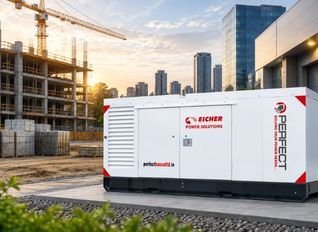
How to Select a Generator for Construction, Industrial and Commercial Applications
The right generator depends on more than the amount of electricity an application consumes.
A construction site, industrial facility and commercial building can all require backup or primary power, but their load profiles, operating schedules, site conditions and power requirements can be very different.
For example, a construction project may need temporary power for equipment and site facilities, while an industrial facility may need to support motors, pumps and production machinery. A commercial building may instead prioritize reliable backup power for critical building systems.
Selecting the generator according to the actual application helps ensure that the system is appropriately matched to the required load and operating conditions.
This guide explains the key factors to consider when selecting a generator for construction, industrial and commercial applications.
Why Application Matters When Selecting a Generator
A generator should be selected according to how it will be used.
Two businesses can have similar total electrical loads but require different generator configurations because of differences in:
- Equipment
- Operating hours
- Starting loads
- Power requirements
- Site conditions
- Backup requirements
- Future expansion
- Automation requirements
Before selecting a generator, establish the application’s electrical and operational requirements.
Application → Load → Operating Profile → Site Conditions → Generator Configuration
1. Determine the Electrical Load
The first step is to identify everything that the generator may need to power.
Create a list of:
- Lighting
- HVAC systems
- Pumps
- Motors
- Compressors
- Production equipment
- IT equipment
- Refrigeration
- Tools and machinery
- Other electrical loads
Then determine:
- Running load
- Starting load
- kW requirement
- kVA requirement
- Power factor
- Maximum expected load
Simply adding equipment wattages may not be enough, particularly where motors and other equipment have significant starting requirements.
For a detailed calculation, see our guide on how to calculate generator capacity.
2. Consider Whether You Need Prime or Standby Power
The generator’s intended duty is another important consideration.
Standby Power
A standby generator is generally used as a backup when the normal utility supply becomes unavailable.
This can be suitable for:
- Commercial buildings
- Offices
- Industrial facilities
- Homes
- Critical facilities
- Other applications requiring backup power
The generator may remain available for operation and start when the normal supply fails, depending on the control configuration.
Prime Power
A prime-power generator can serve as the primary source of electrical power under defined operating conditions.
This can be relevant for:
- Construction sites
- Remote projects
- Temporary facilities
- Industrial operations
- Locations where utility power is unavailable or insufficient
For more information, see our guide to prime power vs standby power generators.
Generator Selection for Construction Applications
Construction sites have some of the most variable power requirements.
The electrical load can change as the project progresses, and equipment may need to be moved or added as different phases of construction begin.
A construction generator may need to supply:
- Site offices
- Lighting
- Power tools
- Pumps
- Compressors
- Welding equipment
- Temporary facilities
- Construction machinery
The generator should therefore be selected according to the actual equipment and expected operating profile rather than simply estimating the requirement based on project size.
3. Consider Equipment Starting Loads on Construction Sites
Construction equipment can include motors, pumps and compressors that require additional electrical power when starting.
For example, if several motor-driven machines need to start at the same time, the instantaneous electrical demand can be significantly higher than their combined running load.
Before selecting the generator, determine:
- Largest motor
- Motor starting method
- Starting current
- Which equipment starts simultaneously
- Whether loads can be started sequentially
This can help avoid selecting a generator that is adequate for normal running load but struggles when equipment starts.
4. Consider Mobility for Construction Projects
Mobility can be important when power requirements change across a construction site.
If the generator needs to be moved between work areas, portability or an appropriate mobile-generator arrangement may be useful.
For smaller temporary requirements, a portable generator may be suitable depending on the required capacity.
For larger construction projects requiring substantially more power, a higher-capacity diesel generator may be more appropriate.
The choice should be based on the required capacity, equipment, operating duration and site layout.
5. Consider the Construction Environment
Construction sites can expose equipment to demanding conditions.
Consider:
- Dust
- Temperature
- Moisture
- Ventilation
- Site access
- Noise
- Weather exposure
- Fuel storage
- Cable routing
The generator enclosure and installation arrangement should be appropriate for the environment.
Proper installation also needs to account for exhaust, cooling airflow, electrical distribution and safe access for maintenance.
Generator Selection for Industrial Applications
Industrial facilities can have significantly more complex electrical requirements than smaller commercial installations.
Industrial loads may include:
- Production machinery
- Large motors
- Pumps
- Compressors
- Conveyors
- Process equipment
- HVAC systems
- Automation equipment
Because these loads can operate simultaneously or have substantial starting requirements, industrial generator selection should normally begin with a detailed load assessment.
6. Consider Motor Loads in Industrial Applications
Motors can have a significant impact on generator selection.
When a motor starts, its electrical demand can temporarily increase.
If several motors start simultaneously, the generator may need to handle a much higher instantaneous demand.
When evaluating an industrial generator, identify:
- Motor ratings
- Starting method
- Starting current
- Motor sequence
- Running load
- Critical motors
In some systems, sequential starting can help manage the instantaneous load, but the appropriate approach depends on the equipment and electrical-system design.
7. Consider Multiple Generators for Large Industrial Loads
Large industrial facilities may require more capacity than can reasonably be provided by a single generator.
In such applications, multiple generator sets can potentially operate together.
This may require:
- Synchronization
- Load sharing
- Generator sequencing
- Protection
- Automatic controls
Perfect House’s control-panel range includes synchronizing panels and PLC-based automation panels for applications requiring more advanced generator control.
Multiple-generator systems should be designed around the complete electrical architecture rather than simply connecting several generators together.
8. Consider Generator Redundancy
For applications where power availability is particularly important, generator redundancy may be considered.
Instead of relying on a single generator, multiple generator sets can potentially provide additional flexibility.
Depending on the system design, this can allow:
- Maintenance of individual generator sets
- Flexible capacity
- Load sharing
- Backup capacity
- Staged generator operation
Whether redundancy is appropriate depends on the application’s criticality, required capacity and system design.
Generator Selection for Commercial Applications
Commercial facilities can have a wide variety of electrical loads.
A commercial generator may need to support:
- Lighting
- HVAC
- IT equipment
- Security systems
- Pumps
- Refrigeration
- Elevators or lifts
- Building services
The first step is to identify which loads are critical during a power interruption.
Not every electrical load necessarily needs to operate during a utility failure.
9. Identify Critical Loads
A commercial building can divide electrical loads into categories such as:
Critical Loads
Systems that need to remain operational during an outage.
Examples may include:
- Security
- Emergency systems
- IT infrastructure
- Selected lighting
- Critical equipment
Non-Critical Loads
Systems that can remain disconnected during an outage if the power-system design allows it.
Identifying critical loads can help define the generator capacity and electrical distribution requirements.
10. Consider Automatic Generator Operation
Commercial applications often benefit from automatic generator operation.
An Automatic Mains Failure (AMF) system can detect a qualifying utility failure and initiate the generator start sequence.
An Automatic Transfer Switch (ATS) can manage the transfer of designated loads between the utility and generator supply according to the system configuration.
A typical sequence is:
Utility failure → Generator starts → Generator reaches operating conditions → Load transfers
When the normal supply returns, the system can transfer the load back according to its configured sequence.
Perfect House provides DG Manual/AMF/ATS panels as part of its control-panel range.
11. Consider Fuel Consumption and Operating Costs
Generator selection should not focus only on the initial purchase price.
For regularly operated generators, consider:
- Fuel consumption
- Operating hours
- Maintenance
- Spare parts
- Service requirements
- Expected operating life
Fuel consumption can vary according to generator model and load.
A generator operating at a high load for extended periods can have very different fuel requirements from one used occasionally for emergency backup.
Therefore, estimate operating costs using the actual expected load profile wherever possible.
12. Consider Site Conditions
Environmental conditions can affect generator selection and installation.
Important factors include:
Temperature
High ambient temperatures can influence engine and cooling-system performance.
Altitude
Altitude can affect engine performance because of changes in air density.
Dust
Mining, construction and some industrial environments can expose generators to significant dust.
Ventilation
Adequate airflow is required for cooling and combustion.
Noise
Commercial and urban applications may require appropriate acoustic considerations.
Weather
Outdoor installations may require appropriate protection from environmental exposure.
13. Consider the Generator Control System
The control system should be evaluated as part of the generator package.
Depending on the application, you may need:
- Manual control
- AMF
- ATS
- Generator monitoring
- Synchronization
- Load sharing
- PLC automation
- Remote monitoring
A simple backup generator may require only basic automatic operation, while a multi-generator industrial installation can require considerably more advanced control.
The generator control panel should therefore be selected according to the complete electrical system.
14. Consider Future Load Growth
A generator installation should also take realistic future requirements into account.
For example, a commercial facility may later add:
- HVAC equipment
- Servers
- Pumps
- Lighting
- Charging systems
An industrial facility may add:
- Production lines
- Motors
- Compressors
- Process equipment
If expansion is already planned, it should be considered during the initial system design.
However, simply adding a large amount of hypothetical capacity can result in unnecessary oversizing.
Construction vs Industrial vs Commercial Generator Selection
The following comparison provides a useful starting point:
| Requirement | Construction | Industrial | Commercial |
|---|---|---|---|
| Typical power role | Temporary / prime / backup | Prime or standby | Mainly standby |
| Load profile | Often variable | Often complex | Usually defined |
| Motor loads | Common | Often significant | Depends on facility |
| Mobility | Can be important | Usually fixed | Usually fixed |
| Starting loads | Important | Very important | Important where motors are present |
| Synchronization | Project-dependent | Common in larger systems | Project-dependent |
| AMF/ATS | Depending on application | Depending on system | Common for automatic backup |
| Future expansion | Project-dependent | Often important | Important |
These are general application characteristics. The actual generator should always be selected according to the specific project’s electrical and operating requirements.
How to Choose the Right Generator for Your Application
Before selecting a generator, work through these questions:
1. What Will the Generator Power?
List all equipment and systems.
2. What Is the Total Running Load?
Calculate the normal electrical requirement.
3. What Are the Starting Loads?
Identify motors, pumps, compressors and other high-starting-current equipment.
4. Is the Generator for Prime or Standby Power?
This determines the expected operating role.
5. How Many Hours Will It Operate?
Operating duration affects fuel, maintenance and duty considerations.
6. Is Mobility Required?
This can influence whether a portable or fixed generator is appropriate.
7. What Are the Site Conditions?
Consider temperature, altitude, dust, ventilation, weather and noise.
8. What Control Functions Are Required?
Determine whether you need AMF, ATS, synchronization, load sharing or automation.
9. Is Future Expansion Expected?
Consider realistic planned load growth.
Common Generator Selection Mistakes
Selecting Based Only on kVA
Generator capacity is important, but it isn’t the only factor.
Ignoring Starting Loads
Motors and compressors can significantly affect the required generator capacity.
Choosing the Largest Generator Available
Oversizing can increase purchase and operating costs without providing a practical benefit.
Ignoring the Operating Environment
Temperature, altitude, dust and ventilation can affect the generator installation.
Treating Construction and Industrial Requirements as the Same
Construction loads can be temporary and variable, while industrial loads may involve complex machinery and long operating periods.
Selecting the Control Panel Separately
The control system should be considered as part of the overall generator installation.
Generator Selection Checklist
Before requesting a generator quotation, prepare:
- Application type
- Required kVA
- Required kW
- Running load
- Starting load
- Largest motor
- Power factor
- Prime or standby requirement
- Expected operating hours
- Fuel requirements
- Site conditions
- Indoor/outdoor installation
- Mobility requirements
- AMF requirement
- ATS requirement
- Synchronization requirement
- Future load requirements
Having this information available makes it easier to evaluate an appropriate generator configuration.
Final Thoughts
Selecting a generator for construction, industrial or commercial applications requires an understanding of both the electrical load and the environment in which the generator will operate.
Construction projects may prioritize temporary power, changing loads and mobility. Industrial facilities can require higher capacity, motor-starting capability, synchronization and more advanced control systems. Commercial buildings may place greater emphasis on reliable backup power and automatic transfer of critical loads.
The right generator should therefore be selected by evaluating the application, running and starting loads, operating profile, site conditions, control requirements and future needs together.
Rather than choosing a generator solely by its kVA rating, take the time to understand what the generator actually needs to do.
For more information, explore the generator range or review our guide on calculating generator capacity.