




How to Choose the Right Generator for Home, Commercial and Industrial Power Requirements
Choosing a generator is not simply about selecting the highest available power rating. The right generator depends on what you need to power, how much power your equipment consumes, how often the generator will operate, and the conditions in which it will be installed and used.
A generator selected without considering these factors can be unnecessarily expensive, inefficient or unsuitable for the intended application.
Whether you need backup power for a home, dependable power for a commercial facility or a high-capacity solution for an industrial application, the selection process should begin with the actual power requirement.
This guide explains the key factors to consider when choosing a generator.
1. Start With Your Application
The first question to ask is:
What will the generator be used for?
The answer affects almost every other part of the selection process.
Residential Applications
Homes may require a generator to support essential loads such as:
- Lighting
- Refrigeration
- Fans and air conditioning
- Water pumps
- Security systems
- Communication equipment
- Selected household appliances
A residential application generally has a different load profile from a factory or commercial facility, so the generator should be sized according to the appliances and systems that actually need backup power.
Commercial Applications
Commercial buildings may have considerably more varied electrical requirements, including:
- Lighting systems
- HVAC equipment
- Pumps
- Lifts
- IT equipment
- Security systems
- Office equipment
- Retail equipment
For commercial applications, it is important to understand both the normal operating load and equipment that may have high starting requirements.
Industrial Applications
Industrial facilities can have more complex and demanding power requirements. Loads may include:
- Motors
- Pumps
- Compressors
- Production machinery
- Process equipment
- Control systems
- Material-handling equipment
Industrial generator selection therefore requires a more detailed assessment of load characteristics, starting currents, operating conditions and required duty.
2. Determine How Much Power You Need
One of the most important steps in generator selection is determining the required capacity. Generators are commonly specified in kVA, while electrical equipment may be rated in watts or kilowatts.
The generator should not simply be selected based on the largest individual appliance or machine. You need to consider the combined electrical load that the generator is expected to supply.
Start by Listing Your Loads
Create a list of the equipment that will operate from the generator.
For example:
| Equipment | Approx. Load |
|---|---|
| Lighting | 5 kW |
| Air conditioning | 15 kW |
| Pumps | 10 kW |
| Office equipment | 5 kW |
| Other equipment | 10 kW |
| Total | 45 kW |
This is only an illustrative example. Actual equipment ratings and operating conditions should be used for a real generator-sizing exercise.
3. Understand kW and kVA
A common mistake when choosing a generator is treating kW and kVA as the same thing.
They are related, but they represent different electrical quantities.
The relationship is commonly expressed as:
kW = kVA × Power Factor
For example, at a power factor of 0.8:
100 kVA × 0.8 = 80 kW
This means a 100 kVA generator at a power factor of 0.8 corresponds to approximately 80 kW of real power.
The actual generator selection should consider the characteristics of the connected loads rather than relying on a simple conversion alone.
4. Consider Starting Loads
Running power is only part of the calculation. Some equipment, particularly motors, pumps and compressors, can require significantly more power when starting than when operating normally.
This is known as starting or transient load.
For example, a motor may operate at a relatively moderate running load but require substantially higher current during startup.
If these starting requirements are ignored, a generator may experience:
- Voltage dips
- Frequency fluctuations
- Difficulty starting equipment
- Generator overload
- Unstable operation
Therefore, when selecting a generator for an application with motors or other high-starting-current equipment, the starting characteristics should be included in the assessment.
5. Decide Between Standby and Prime Power
Another important consideration is how the generator will be used.
Standby Power
A standby generator is generally used as a backup source when the primary utility supply is unavailable.
Typical applications include:
- Homes
- Offices
- Commercial buildings
- Healthcare facilities
- Data and communication facilities
- Industrial sites requiring backup power
The generator normally remains available for operation when required rather than functioning as the primary source of electricity.
Prime Power
Prime power applications are different. A prime power generator can be used where the generator is required to provide the primary electrical supply under defined operating conditions.
This can be relevant for:
- Remote sites
- Temporary power applications
- Construction projects
- Industrial operations
- Locations without reliable grid access
The required generator configuration should therefore be based on the expected operating profile rather than simply the maximum possible load.
6. Consider Operating Hours
Think about how frequently the generator will operate. There is a significant difference between a generator that runs occasionally during power failures and one that operates for extended periods.
Consider:
- Expected operating hours
- Daily load profile
- Required autonomy
- Fuel availability
- Maintenance requirements
- Expected operating environment
For example, a generator used only during occasional utility interruptions has different requirements from one supporting continuous operations at a remote project site.
7. Choose the Appropriate Generator Capacity
Once the load and application have been assessed, you can determine an appropriate generator capacity.
The goal is not to simply choose the biggest generator available. An oversized generator can result in unnecessary capital expenditure and inefficient operation, while an undersized generator can struggle with the connected load.
The selection should provide sufficient capacity for:
- Normal operating loads
- Starting requirements
- Expected load growth
- Required operating conditions
- Appropriate operating margin
Professional load assessment is particularly important for larger commercial and industrial installations.
8. Consider the Operating Environment
The location where the generator operates can affect its performance and configuration.
Consider factors such as:
Ambient Temperature
High ambient temperatures can affect engine and cooling-system performance.
Altitude
At higher elevations, air density decreases, which can affect engine performance and available power.
Dust and Contamination
Construction, mining and industrial environments may expose equipment to higher levels of dust and contaminants.
Ventilation
Generators require appropriate airflow for cooling and combustion.
Noise
Residential, commercial and institutional applications may require appropriate acoustic considerations.
Installation Location
The generator may be installed indoors, outdoors or within a dedicated enclosure depending on the project. These factors should be considered during generator selection rather than after the equipment has been purchased.
9. Consider the Engine and Alternator
A generator is more than an engine. The complete generating set typically includes the:
- Engine
- Alternator
- Control system
- Cooling system
- Fuel system
- Exhaust system
- Protection systems
- Acoustic enclosure where applicable
The engine provides the mechanical power required to drive the alternator, while the alternator converts that mechanical energy into electrical power.
The engine and alternator combination should therefore be appropriate for the required capacity and duty.
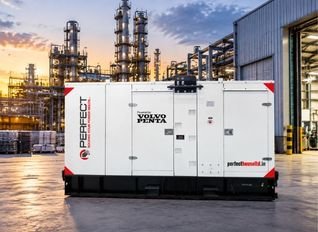
The Perfect Global Generators range includes generator sets using platforms such as Perkins and Volvo, as well as higher-capacity Baudouin models. For example, the site’s 250 kVA Volvo-powered generator uses a Volvo TAD843GE engine, while its 250 kVA Perkins model uses a Perkins 1206A-70TTAG3 engine.
10. Don’t Overlook the Generator Control Panel
The control system is an important part of a modern generator installation.
A generator control panel can provide functions related to:
- Generator monitoring
- Engine parameters
- Voltage and frequency
- Protection
- Alarms
- Automatic operation
- System status
For more advanced installations, control systems can also be integrated with AMF, ATS, synchronization and automation systems.
Perfect House’s control-panel range includes DG Manual/AMF/ATS panels, synchronizing panels and PLC-based automation panels, alongside other electrical control and distribution systems.
For larger or more complex power systems, the control architecture should be considered during the generator selection stage.
11. Consider Fuel Efficiency and Operating Cost
The purchase price is only one part of the total cost of owning a generator.
For generators that operate regularly, consider:
- Fuel consumption
- Maintenance requirements
- Service intervals
- Spare parts availability
- Operating hours
- Load profile
- Expected service life
Fuel consumption can vary depending on generator size, load and operating conditions. For example, published specifications for Perfect’s 80 kVA Perkins generator provide separate fuel-consumption figures at 75% and 100% load, demonstrating why operating load should be considered when evaluating running costs.
12. Think About Maintenance and Service
A generator is a mechanical and electrical system that requires regular maintenance.
A suitable maintenance program can include inspection of:
- Engine oil
- Coolant
- Fuel system
- Batteries
- Belts and hoses
- Air filters
- Electrical connections
- Alternator
- Control system
- Exhaust system
Maintenance requirements vary according to the generator model and operating conditions. For example, the published specifications for some Perfect Perkins generator models specify a 500-hour or 12-month service interval, whichever comes first. Always follow the maintenance schedule specified for the particular generator model.
13. Generator Selection by Application
There is no single generator configuration that is ideal for every situation.
Home
Focus on:
- Essential loads
- Backup duration
- Noise
- Space
- Automatic changeover requirements
Commercial
Focus on:
- Building load
- HVAC and pumps
- Critical equipment
- Backup requirements
- Automatic operation
Construction
Focus on:
- Temporary power requirements
- Equipment starting loads
- Site conditions
- Mobility
- Operating hours
Industrial
Focus on:
- Total connected load
- Motor starting
- Prime or standby duty
- Load growth
- Synchronization requirements
- Environmental conditions
- Maintenance support
Remote Applications
Focus on:
- Prime power requirements
- Fuel storage
- Operating hours
- Service accessibility
- Environmental conditions
- System redundancy
14. What Size Generator Should You Choose?
There is no universal generator size for a particular type of customer. A “home generator,” for example, can have very different requirements depending on the number of appliances, HVAC systems, pumps and other loads being supported.
Likewise, two factories with the same building size may require very different generator capacities because their machinery and operating loads are different.
A better approach is to determine:
Application → Connected Load → Running Load → Starting Load → Duty → Operating Conditions → Required Capacity
This provides a more reliable basis for generator selection than choosing a generator based only on the building size or a single piece of equipment.
15. Generator Selection Checklist
Before purchasing a generator, review the following:
Electrical Requirements
- What equipment needs to be powered?
- What is the total running load?
- Are there high starting-current loads?
- What is the required kVA/kW capacity?
- What power factor applies?
Operating Requirements
- Is the generator standby or prime?
- How many hours will it operate?
- What load will it normally carry?
- Is future load growth expected?
Site Requirements
- What is the ambient temperature?
- What is the site altitude?
- Is the environment dusty or harsh?
- Is indoor or outdoor installation required?
- Are noise considerations important?
System Requirements
- Is automatic mains failure required?
- Is an ATS required?
- Is synchronization required?
- Is remote monitoring required?
- What protection functions are required?
Ownership Requirements
- What are the expected fuel costs?
- What maintenance is required?
- Are spare parts and technical support available?
- What service schedule applies?
Common Mistakes to Avoid
Choosing a Generator Only by kVA
Capacity is important, but it is not the only consideration. Starting loads, duty, environment and operating profile also matter.
Choosing an Oversized Generator
A larger generator is not automatically a better generator. The equipment should be appropriately matched to the expected load.
Ignoring Motor Starting Loads
Pumps, compressors and motors can create significant starting demands.
Focusing Only on Purchase Price
Fuel, maintenance, servicing and operating hours contribute to the total cost of ownership.
Ignoring the Control System
For many commercial and industrial applications, generator monitoring, protection, AMF, ATS or synchronization can be an important part of the overall power system.
Not Considering Future Requirements
If the facility is expected to add significant electrical loads, future requirements should be considered during the initial selection.
Final Thoughts
Choosing the right generator starts with understanding the application and the actual electrical requirement.
The correct selection should consider capacity, running and starting loads, standby or prime operation, environmental conditions, fuel requirements, control systems, installation and ongoing maintenance.
For smaller residential requirements, a compact generator may be appropriate. Commercial and construction applications can require larger and more flexible power solutions, while industrial and prime-power applications may require higher-capacity generator systems and more advanced control arrangements.
The most effective approach is to evaluate the complete requirement rather than selecting a generator based on capacity alone.
If you are unsure which generator configuration is appropriate for your application, a detailed assessment of your load, operating profile and site conditions can help identify a suitable solution.
Explore the generator range or contact Perfect House to discuss your power requirement.